Sunday, May 4, 2014

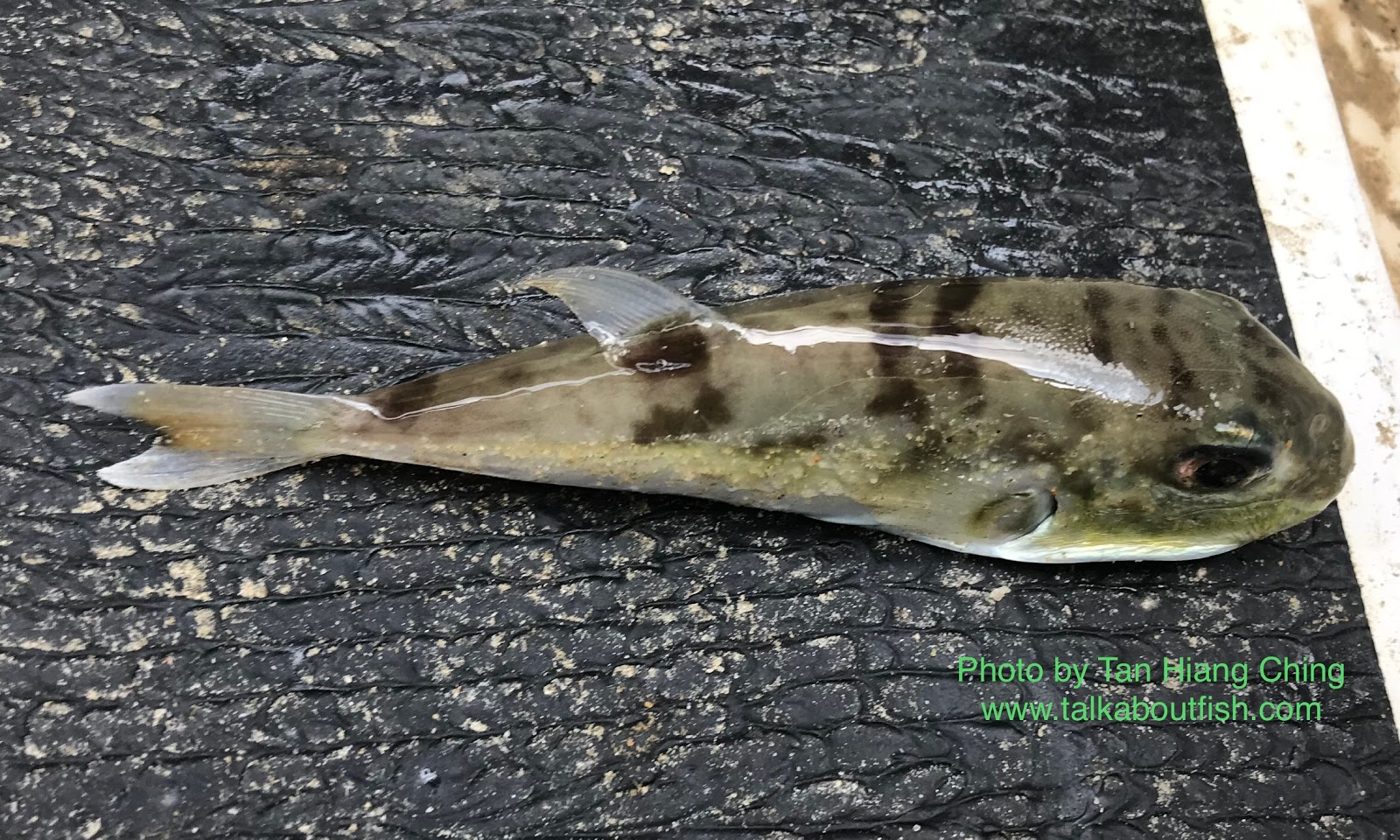
Marine Catfishes

Marine catfishes or fork-tailed catfishes are the common names used for the members of Ariidae family. They occur in saltwater, brackish, and fresh waters of tropical and subtropical oceans. They are mainly saltwater fishes that sometimes enter freshwater. Some species are only found in freshwater. They have forked caudal fin, 3 pairs of barbels (rarely 2 pairs), and bony plates on head and near dorsal fin. They have 3 long, hard, usually serrated spines on their dorsal and pectoral fins. These spines are venomous.

Marine catfishes are bottom-living fishes found in mangrove areas, large river estuaries, and turbid waters, as well as in fully marine waters and clear fresh waters. Some of them are omnivorous and some feed on small fishes, molluscs and crustaceans.

There are 30 genera and more than 150 species of Ariidae worldwide. Malaysia has 11 genera and about 25 species, with 3 species that enter freshwater.

Below are some of the marine catfishes found in Malaysia.


Family Name: Ariidae
English Name: Marine Catfish
Mandarin Name: 成魚 (Chéng yú), 海鯰 (Hǎi nián)
Local Malay Name: Ikan Duri, Pedukang
Local Hokkien: Sai Seng, Ah Seng


Sunday, May 13, 2012

Karnival Tanjung Leman 2012

The event was held on 11th May to 13th May 2012. It's one of the yearly huge event in Tanjung Leman where the Sultan of the state and high ministers visited.
I was there on 13th May so I joined their beach fishing competition which started at 9 am. I arrived at about 9:30 am, paid the 60 Ringgit fee and get a place in front of the Felda Residence. This is where stingray are usually landed. Actually I was reluctant to join because I do not have a beach rod but I figured that I need to join in the fun.
The whole beach from Tunjuk Laut chalet to pass Felda Residence was full of surf fishing rod. Many times fishing lines were entangled and it was low tide almost all the way until 1:30 pm when the finishing horn finally blowed. Not many fishes were landed and I was told that the winner of the competition won only with a 900 grams sting ray.
Although it was quite fun to experience my first fishing competition, this is also the first time I came back from Tanjung Leman with an empty icebox.

Singing competition

Temporary stores set up to make some money

Rods on my right


More rods on my left

Salleh in action

Bikes of the Kembara Mahkota arriving

Thursday, April 12, 2012

Musim Ketarap

After a long break since the NE Monsoon started in October last year, finally Salleh invited me over to Tanjung Leman to fish for Blackspot Tuskfish. This fish is one of the most expensive fish from this area although in term of personal preference, I still prefer John’s Snapper. The fish can be easily identified by the black spot at the back of it's body. This black spot only become distinct after the fish is landed for a certain time.
We started fishing at about 8 am. We're using life prawns, dead prawns and squid as bait but all 7 Tuskfish were caught using life prawn. Initial Tuskfish bite felt like a small fish but when the fish is hooked, a 1kg tuskfish felt like a 3-5kg fish. Almost all of them were caught when the sunlight was bright.

Nasir got the fist one

Salleh got his Ketarap

I'm under pressure now

Finally

Monday, March 19, 2012

Southern Winds and Inter-monsoon

Southwest Monsoon season in Peninsular Malaysia is characterized by winds that blow from the southwest starting from late May to September. It is associated with the rise of temperature in the Asian continent and the temperature drop in the southern hemisphere. In the southern hemisphere the wind blows from Southeast direction and changes direction to southwest as it passes the equator. This effect is called the Coriolis Effect which is caused by the rotation of the earth.

During the southwest monsoon period, rainfall in the Peninsular Malaysia will reduce as rainfall in the western Sumatra peaks when the monsoon wind passes through the Barisan Mountains, a mountain range on the western side of Sumatra.


Calm sea during the SW monsoon in the east coast of Peninsular Malaysia

Sumatra Squalls or Ribut Sumatra are thunderstorms which usually occur from April to May and from September to October each year during the inter-monsoon periods. These squalls develop at night over Sumatra or the Straits of Malacca and move east toward Peninsular Malaysia usually during dawn and early morning. Squall are characterized by sudden onset of strong gusty winds of up to 100 km/hour and heavy rain to the southwestern part of Peninsular Malaysia starting from the state of Selangor to Johor.

Sea breezes are common during the inter-monsoon and southwest monsoon season. The winds are formed as a result of temperature differences between land and sea. In the day, land gets heated rapidly by the sun while sea surface temperature increases less. When hot air rises over the land, cool air just above the sea moves inland to fill the void and circulate back to sea higher above. Sea breezes and opposing light constant wind can sometimes initiate thunderstorm that usually align with the coastline.

Waterspout is rare in Peninsular Malaysia but if it happens usually will be in the inter-monsoon periods. Waterspout occur during intense weather condition associated with thunderstorm and often being mistaken  as a tornado due to the similar appearance. Unlike tornado that can occur over both land and sea, waterspout only forms over the sea. It usually dissipate on reaching the coast.


Waterspout in Tanjung Leman


From April onward, the east coast of Peninsular Malaysia sea will start to calm down. Fish species like grouper, snapper, wrasse and sweetlips will move closser to the shore. Good time for fishing will be back for anglers until October.


Grouper is abundant in Tanjung leman during the SW monsoon

Saturday, December 10, 2011

Northeast Monsoon

The two main monsoon seasons in Malaysia are the Northeast Monsoon and the Southwest Monsoon Season. In between the two monsoon there are two short inter-monsoon periods which are the Pre South-West Monsoon and Pre North-East Monsoon. The monsoon that affects the living of the Peninsular Malaysia east coast, particularly those in the fishing industry is mainly the Northeast Monsoon which will bring strong wind and rainfall from November to January.

Northeast Monsoon season is characterized by constant winds that blow from the northeast. It is associated with the development of the Siberian High which is a massive collection of cold dry air on the Eurasian terrain and the movement of the heating maxima from the Northern Hemisphere to the Southern Hemisphere. Northeasterly winds flow down Southeast Asia with wind speeds reaching as high as 30 to 40 km/hr.


Rough sea in NE monsoon season even after sheltered by the Seribuat Island 

During the season, the states in the east coast of Peninsular Malaysia, coastal areas of Sarawak and Sabah will experience episodes of heavy rain continued for a total of two to three days due to monsoon surges. In the case of extreme weather,the whole episode of heavy rain can last for three to eight days, and may cause flood. However, there are usually several days of good weather that is either with no rain or little rain that occur between the heavy rainfall episodes.

The northeast monsoon causes most of the Peninsular east coast fishermen not able to continue fishing. Many fishermen will start to face with monetary issues and turn to the middleman for loan. The fisherman in Tanjung Leman is a little more lucky because their fishing area is located behind the Seribuat islands. There are some days that strong wind and thunderstorm will disrupt their fishing routine but they will still be able to fish during the season.


Highly sought after Yellow Croaker or Gelama Mas in Malay

The monsoon season also changes the species of fish caught by the fishermen in the east coast. During the beginning of the season, fish species from the mackerel and threadfin family will be abundant. The highly sought after Yellow Croaker that is gold in color is one of the species that can only be found during Northeast Monsoon. Spiny lobster will also move in nearer to shore and become abundant. Grouper on another hand will become scarce as they move further out into the sea.

Friday, November 4, 2011

Johor Regatta 2011

Here are some of the beach scene taken last weekend for KFC Felda Johor Open 2011. The match are held on 28-30th October at Tanjung Leman. We're not allowed to carry out our usual boating activities during the occasion.

Scene with the Pulau Tinggi and Pulau Sibu in the background.


Contestants coming back.


I like this picture best.


Tuesday, October 4, 2011

Puffer and non-edible fishes


The catch was terrible last Saturday and I get all sorts of non edible fish. Yeah! At last one page for the puffer fish!

This one is a beauty, it is called Black-blotched porcupinefish or Diodon liturosus. This is quite common here I think. I've got this twice so far.


This one is called Half-smooth golden pufferfish or Lagocephalus Spadicus.


Another puffer fish from the Lagocephalus genus, Lagocephalus Guentheri or Diamondback Puffer.


This is Lagocephalus Suezensis.


A dried Lagocephalus Lunaris.


Fresh Lagocephalus Lunaris


Arothron stellatus or Starry pufferfish.


Arothron reticularis or Reticulated Pufferfish


This one below is a juvenile Immaculate pufferfish or Arothron Immaculatus.


This species is called Map puffer or Arothron mappa


This species is called Green pufferfish or Tetraodon fluviatilis


Spotted green pufferfish or Tetraodon nigroviridis.


This one is the Shortnose boxfish or Rhynchostracion nasus.


Another boxfish species, Lactoria cornuta (Linnaeus, 1758), Longhorn cowfish


This one is not a puffer fish species. It's a dangerous scorpion fish that can inflict a painful injury with it's venomous dorsal sting. It's a Raggy Stonefish or Scorpaenopsis venosa (Cuvier, 1829)


Here is another venomous scorpion fish. It's a Tassled scorpionfish or Scorpaenopsis oxycephala  (Bleeker, 1849).


This one below is either a Butterflyfish or Angelfish species, suitable for aquarium. It's correct name is still unknown to me. Let me know if you have any idea what it's called.


This one is common aquarium fish, called Copperband butterflyfish or Chelmon rostratus (Linnaeus, 1758).